Theories and Framework Discussion
Tonight I felt was a great Skype session. Leading off of Michael’s topic of ‘Why do boys lose interest in dance?’ We discussed this in detail and Helen kindly explained how the framework is - Boys in dance in UK and how the theory is what spoke about, from social development, peer pressure, social media and psychological aspects. After this discussion I feel more confident in my understanding of frameworks and theories. Michael’s topic is a great talking point as so many of us have experienced a lack of boys or boys experiencing peer pressure so it’s great to hear others thoughts on the matter.
Some valid points about disagreeing with a scholar’s opinion was also in our chat tonight. I would eventually like to research ‘disability in dance’ I found it fascinating to hear of ‘Sarah Whatley’s’ Article. I have had a quick look and noted down. A disability is not always disabling. Difference of opinions and disagreements gives me a certain fire in my belly so I shall certainly look into this research further.
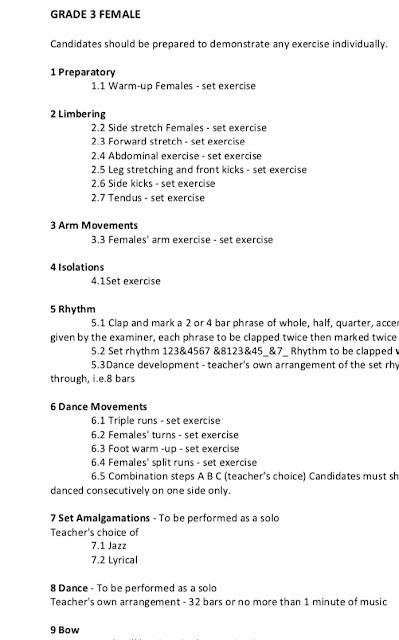
What I brought to the table was how the ISTD does not allow boys to perform the set lyrical pieces of the syllabus. Most of my boys are quite lyrical and are often annoyed why they cannot dance it. Below as promised is the print out from the syllabus in modern. You can clearly see the option is not available. 7.1 is the same for boys and girls and 7.2 is lyrical for girls and the search for boys. I have contacted the society before regarding this and the answer is just a simple ‘no’. The girls vice versa cannot perform the boys dance but the point is the boys work isn’t of a lyrical content.

Some valid points about disagreeing with a scholar’s opinion was also in our chat tonight. I would eventually like to research ‘disability in dance’ I found it fascinating to hear of ‘Sarah Whatley’s’ Article. I have had a quick look and noted down. A disability is not always disabling. Difference of opinions and disagreements gives me a certain fire in my belly so I shall certainly look into this research further.
What I brought to the table was how the ISTD does not allow boys to perform the set lyrical pieces of the syllabus. Most of my boys are quite lyrical and are often annoyed why they cannot dance it. Below as promised is the print out from the syllabus in modern. You can clearly see the option is not available. 7.1 is the same for boys and girls and 7.2 is lyrical for girls and the search for boys. I have contacted the society before regarding this and the answer is just a simple ‘no’. The girls vice versa cannot perform the boys dance but the point is the boys work isn’t of a lyrical content.



Thanks for sharing this 'data' Jade...I was not doubting your experiences, more wondering what you might do now to challenge this...thinking about your own practice, what theories might you look to to learn more?
ReplyDeleteHi Helen,
DeleteBeen thinking about this and what we chatted about last night, also what I posted below to 'Koru Youth Theatre' I would maybe have a similar question to 'Michael's' but involving disability. There are certain restrictions in this area I believe could be challenged but in a way I also agree with certain realistic aspects also. I think this might be a good forward thinking task for me. Thanks again for the chat I feel I have a clearer understanding of the topic now.
Hello everyone..Welcome to my free masterclass strategy where i teach experience and inexperience traders the secret behind a successful trade.And how to be profitable in trading I will also teach you how to make a profit of $12,000 USD weekly and how to get back all your lost funds feel free to email me on(brucedavid004@gmail.com) or whataspp number is +22999290178
DeleteHello everyone..Welcome to my free masterclass strategy where i teach experience and inexperience traders the secret behind a successful trade.And how to be profitable in trading I will also teach you how to make a profit of $12,000 USD weekly and how to get back all your lost funds feel free to email me on(brucedavid004@gmail.com) or whataspp number is +22999290178
Hi Jade. I too have faced the same dogmatic separation of genders and expectations of this in dance. Stereotyping not only boy/girl divide but also insisting certain movements are danced in one way and only this way for assessment. Assessments being made on body shape etc. We are moving forward the industry is becoming more diverse and open to new approaches. We have to keep working in our own way to offer choice to our students in the work we put forward, the production of performances to reflect this. This is where I believe improv can allow a space for self-discovery taking the lead from the individual while offering them tools to explore this. Too much analysis stifles creativity. If I analysed every movement I made defining a reason for it I wouldn’t get past Go!!
ReplyDeleteThanks for your comments. I agree and use similar tools like improv or free work to allow the boys zero restrictions but unfortunately when coming to syllabus aspects of the society, rules are to be followed. This isn't my personal interest in my research when I start it, but was interesting talking about restrictions as I want to research disability and again everyone is open to take exams but most will not pass them, there is a certain standard at a certain level. Unfair yet fair to some extent.
DeleteHi Jade. Really interesting blog. Good to hear what happened in the evening session of yesterdays Skype. I taught ISTD Modern Jazz for many years. The girls always wanted to dance the boys work and vice versa. Yes it seems a shame to stereotype our pupils. look at Mathew Bourne's Swan lake. I know the choreography is different from the original version but how beautiful are the male 'swans'! Thank you for introducing me to Sarah Whatley
ReplyDeleteHi Debbie! Thanks for your comments. I saw Matthew Bourne’s Swan Lake many years ago and agree they are just beautiful as swans. Such an amazing show! I can’t take credit for ‘Sarah Whatley’ lol but I wasn’t sure if the person who brought her up wanted to be mentioned just in case. I’ll get round to responding to blogs ASAP and hope you also had a good Skype session in the morning. X
DeleteHi Jade, Thank you for this post and great to read about the evening discussion. It seems like you touched many really interesting topics! I will look up the article you mentioned from Sarah Whathley.
ReplyDeleteI also feel that there are many gender issues in dance (and out side) that should be addressed. Sometimes I feel it already starts with teaching little kids, what stories we use, what images when they improvise, like little girls dancing other things than just fairies and princesses (nothing against fairies, I think they are cool, when they are one among many other stories, not the only one.)
Hi Agata! I mentioned above in Debbie’s response that I cannot take credit for ‘Sarah Whatley’ but I didn’t want to name the person on the chat without permission lol hopefully they will respond with some more details but it was such a rounded discussion that we all had. You make an interesting point Agata I refer to fairies and princesses too I think the music dictates this also, I might think of some different ways to describe although blank at the moment :) thanks again and hope you are well
DeleteOh Agata! I agree completely...I have seen young girls with extremely good physical conditions wander away from dance because fairies ans princesses are not something they identify with on a personal level! There is so much more to dance that we must be cautious, I agree!
DeleteDear Jade: Thank you for sharing all of this! Especially the programme of boys/girls you have attached. I also find the topic of young male dancers dropping out of dance heartbreaking- especially when it comes to the topics of bullying and gender identity.
ReplyDeleteRegarding research and disability, perhaps you will find extremely interesting work in Tara´s inquiry as she is developing work on the topic as her inquiry. For your reference, this is her blog: https://warburtontara.blogspot.com/ she is doing lovely work and you might find the exchange enriching!
Thanks Marianella, and glad you found the pages useful also. :)
DeleteThank you for sharin gmy blog Marianella, Sorry for the late reply guys ive recently swapped over laptops and still trying to figure all this new software out hehe. Im currently updating my blog regarding my inquiry project but yes please have a look and share any comments or thoughts. https://warburtontara.blogspot.com/
DeleteTHANKS TARA
Interestingly some areas of the industry do seem to be taking this area into consideration. At this years Prix de Lausanne competition where were a selection of contemporary solos created by Wayne McGregor that were classed a gender neutral and both male and females dancers performed the same choreography.
ReplyDeletehttps://www.prixdelausanne.org/competition/variations/contemporary-video/#tab3
Thanks Chris for the link! Good to know some society’s can move forward thinking I think it’s a hard topic can boys be lyrical, can girls be stronger? Depends on the individual and body type I suppose :)
DeleteIt starts with the literature in the libraries at school. The choices we give the children and language used to allow ambiguity and many reflections based on the individuals preference. Subtle language - multiple possibilities while leaving an open space for reflection, discussion if so wished, but not at the hands of a rigid agenda or single directive. Language to influence sensory feelings to develop for the individual. Technique is also subjective. You cannot squeeze every hand into one glove. Assessment for children with disabilities should take its place with opportunities to develop inclusivity in dance. I teach drama and all children have the chance to take exams. Dance companies for disabled dancers are exciting and invent full. They explore choreography with wheelchairs, with prosthetics, there must not be limitations.
ReplyDeleteHi everybody, it was me who mentioned Sarah Whatley. I have been looking at her article " Dance and disability: the dancer, the viewer and the presumption of difference" which is a great read and one of my main theories for my inquiry project. The article is from 2007 and it can be found on unihub if you make your way to the library and resources section. It is only avaible online but quite a short article of around 25 pages. its interesting to see how much has changed within the integrated dance scene since then and now. If you want to know more on my inquiry and my research please dont hestiate to send me a messag.
ReplyDeleteMy blog address is https://warburtontara.blogspot.com/
Thank You
Thanks Tara! I didn’t want to share too much without your permission. So glad you posted and will certainly look into this as I feel we both have a passion for inclusive dance I’d love to hear more about your inquiry so I’ll keep checking your page :) just listening to tonight’s chat. Take care x
DeleteNo problem Jade, I certainly wouldn't mind if you ever wanted to share my name or blog. Thank you for your thoughts and comments on my recent post.
DeleteTara x
Hi Jade,
ReplyDeleteThank you for opening this discussion on gender stereotyping in the ISTD syllabus work. It has made me think. As a ballet, modern and tap examiner for the ISTD I obviously aim to promote and support our work but that does not mean that I cannot question its merit. I always remind teachers that any syllabus is just a guideline to help and inform not to dictate. If you want to teach the lyrical work to the boys then you should be free to do so. Boys cannot show the work in the exam, but at least they have had the opportunity to learn and practice it. Hopefully in time this will change and the lyrical exercises may become optional for boys to show if they want, after all by the time they reach vocational level the boys will be expected to show the same lyrical work as the girls (look at the advanced 1 lyrical arm exercise). Of course when boys reach vocational training they are hopefully better equipt to cope with comments from their peers about dance being "for girls".
Just a thought but I am so glad you brought this up as it has made me question how I approach teaching the syllabus.
Catherine
Hi Catherine, thanks for your response! It was a great topic that makes you think. I love our ISTD society and it does pose some questions for sure. Would be interesting to see if there is any changes in the future. My Grade 4 modern girls half have switched to doing the boys turns rather than the girls I suppose they have the option for that exercise. Take care and thanks for posting. :)
Delete